I’ve been doing SEO for 15 years.
And if I’m being honest – the first few years, I was doing it wrong.
Not because I wasn’t putting in the work. I was. But I had the wrong mental models. I was optimizing for the wrong things. And no one told me these things early enough.
These aren’t theoretical mistakes. These are real decisions I made, real clients I worked with, and real results that eventually forced me to change how I think about SEO.
If you’re early in your SEO career, I hope this saves you a few painful years.
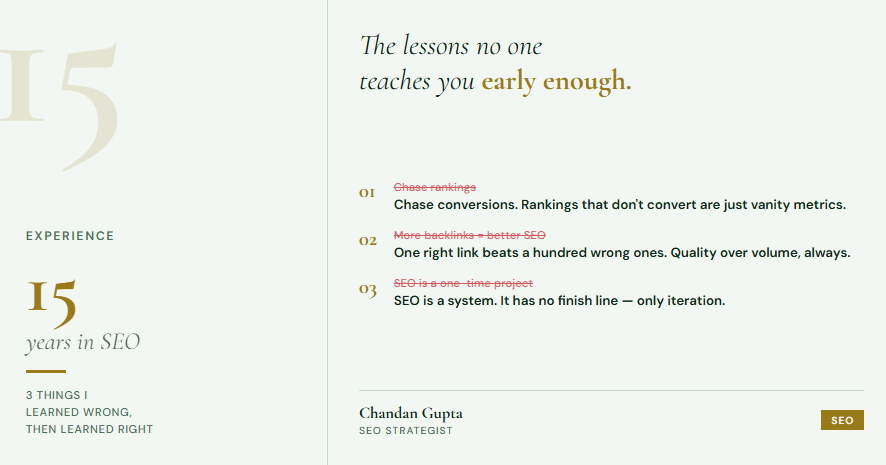
Mistake #1: I Chased Rankings Instead of Results
When I started out, my entire focus was getting clients to Page 1 of Google.
I built reports around ranking positions. I celebrated every time a keyword moved up. I treated rank tracking as the north star of every engagement.
And clients loved it – at first. “We’re ranking #3 for this keyword!” sounds great in a call.
But here’s what I eventually learned: a ranking that doesn’t convert is just an expensive vanity metric.
I had a client ranking #1 for a highly competitive keyword. Traffic was good. But leads? Almost zero. The keyword had informational intent – people were researching, not buying. We were winning the wrong race.
The shift happened when I stopped asking “where are we ranking?” and started asking “who is this visitor, and what are they trying to do?”
That one change – from ranking-first to intent-first — made my audits sharper, my keyword strategies more focused, and my client results significantly better.
What I do now:
Before targeting any keyword, I map it to a stage in the buyer journey. Awareness, consideration, or decision. If a keyword can’t be tied to a business outcome, it goes to the bottom of the priority list – no matter how high the search volume.
Mistake #2: I Thought More Backlinks Meant Better SEO
Early in my career, link building was a volume game for me.
Directories. Guest posts on any site that would take them. Comment links. Private blog networks. If it was a link, I wanted it.
And for a while, it seemed to work. Rankings moved. Clients were happy. I thought I had it figured out.
Then the algorithm updates hit.
Overnight, sites I had spent months building links for dropped off the map. The links that seemed to carry weight suddenly became liabilities. I watched rankings disappear – and had to explain to clients why.
That experience changed my entire approach to link building.
I realized I had been treating links like votes in a popularity contest. More votes, more winning. But Google was getting smarter. It wasn’t just counting links – it was evaluating context, relevance, and authority.
What I do now:
I’d rather earn five high-quality, contextually relevant links than build fifty low-quality ones. I focus on digital PR, genuine partnerships, and content worth linking to. It’s slower. It’s harder. But it compounds – and it doesn’t evaporate when the next algorithm update rolls out.
Mistake #3: I Treated SEO Like a Project. It’s Not. It’s a System.
This one took me the longest to unlearn.
Early on, I approached SEO engagements like a contractor approaches a renovation. You come in, fix things, hand over the keys, and move on. The site is “optimized.” Job done.
I actually said this to clients: “We’ve done the optimization work – you should start seeing results.”
What I didn’t account for: competitors don’t stop. Algorithms keep evolving. User behavior shifts. New search features emerge. What worked in year one doesn’t always work in year three.
Just this week, Google added a Search Console multimodal filter for searches that start with an image.
I had a client who saw great results in the first six months of our engagement. Then they paused the SEO work, thinking the gains would hold. Twelve months later, they came back – rankings had eroded, competitors had caught up, and we were essentially starting over.
That’s when I started framing SEO differently – both for myself and for clients.
What I do now:
SEO is ongoing maintenance, not a one-time fix. I set client expectations upfront: there is no finish line. There is only iteration – monitoring, adapting, improving. The clients who treat SEO as a long-term system consistently outperform the ones who treat it as a project. I run a structured checklist across every audit so nothing gets missed as the site evolves.
The Bigger Lesson Behind All Three Mistakes
Looking back, all three mistakes came from the same root cause: I was focused on outputs instead of outcomes.
Rankings are an output. Backlink counts are an output. A “fully optimized” site is an output.
Conversions, business growth, and sustained organic visibility – those are outcomes.
The shift from output-thinking to outcome-thinking is, in my experience, the single biggest difference between an SEO technician and an SEO strategist.
Final Thoughts
15 years in, I don’t regret making these mistakes. They were the education.
But if you’re earlier in your SEO career, you don’t have to learn them the hard way.
Focus on intent over rankings. Focus on quality over volume. And treat SEO as a long-term system – not a sprint with a finish line.
That’s the advice I wish someone had given me in year one.
Want to see these mistakes in action? Read my breakdown of 7 SEO mistakes I see on every new client website – the same patterns, from a client perspective.
Have a question about SEO strategy or want to discuss your website’s search performance? Get in touch – I’d love to help.

Chandan Gupta is an SEO expert with 15+ years of experience helping businesses improve search visibility. He specializes in technical SEO, local SEO, and on-page optimization. Read his full story →